

Buy Ketamine Online
What is ketamine?
Ketamine is used as an anesthetic for surgery, a treatment for depression, and is a drug of abuse. Ketamine is FDA-approved as an anesthetic to put you to sleep for surgery and to help prevent pain and discomfort. Ketamine for depression is an off-label use, and its use for depression is currently being researched in clinical trials. It is also a drug of abuse that is used illegally recreationally for its hallucinogenic properties and is known to be a “date rape” drug as it causes short-term memory loss.
At anesthetic doses, ketamine induces a state of dissociative anesthesia, a trance-like state providing pain relief, sedation, and amnesia. Its distinguishing features as an anesthetic are preserved breathing and airway reflexes, stimulated heart function with increased blood pressure, and moderate bronchodilation. As an anesthetic, it is used especially in trauma, emergency, and pediatric cases. At lower, sub-anesthetic doses, it is used as a treatment for pain and treatment-resistant depression.
Ketamine is not an opioid (narcotic); it is an NMDA receptor antagonist, which means it blocks the N-methyl-D-aspartate (NMDA) neurotransmitter in the brain.
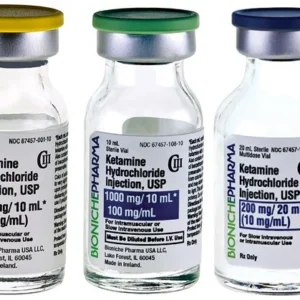
When used for anesthesia, ketamine is given as an intravenous injection (IV) or as an intramuscular injection (IM).
Esketamine (Spravato) is used to treat depression; it is one of the forms of racemic ketamine and was FDA-approved in 2019 for specific types of depression. Spravato is a nasal spray that is used under strict medical supervision and is not used by patients at home.
Ketamine is FDA-approved as a general anesthetic to be used as the sole anesthetic agent for diagnostic and surgical procedures that do not require skeletal muscle relaxation. It is also used to induce anesthesia prior to the administration of other general anesthetic agents and as a supplement to other anesthetic agents. Ketamine is not FDA-approved for depression; it is used off-label for this condition.
Ketamine Therapy
Ketamine infusion therapy has been used for depression in patients with treatment-resistant depression (TRD) for its rapid antidepressant effects. Depression is an off-label use of ketamine as it is not an FDA-approved indication. In clinical trials ketamine therapy is mainly given as intravenous infusion, but may be given as intranasal spray, slow release tablets, sublingual tablets, or other forms.
In clinical trials, ketamine infusions have been given as a single dose once or in multi-dose therapy, as infusions once, twice, or 3 times weekly for 2 weeks during the acute treatment phase. Sometimes infusions have been continued once or twice weekly during the continuation phase for a total of 4–6 weeks of therapy or gradually tapered. In clinical trials ketamine infusion therapy dose is lower than an anesthetic dose. If patients have not responded to several initial infusions, then it appears unlikely that they will respond to further infusions.
Is ketamine a Controlled Substance?
Yes, ketamine is a controlled substance classified as a Schedule III drug under the DEA Controlled Substances Act. This means that ketamine has a potential for abuse that is less than the drugs in schedules I and II. Abuse of the ketamine may lead to a moderate to low potential for physical dependence but high psychological dependence. Drugs that are classified as Schedule III are currently accepted for medical use in treatment in the U.S.
Why is ketamine abused?
Ketamine is abused illegally due to its hallucinogenic and dissociative effects. It leads to changes in sensory experiences, dream-like states, and also a distortion of sights, colors, sounds, self, and one’s environment. Common ketamine street names are Special K, K, super k, ket, ketters, vitamin K, cat tranquilizer, C or horse trank. Ketamine for abuse is usually a clear liquid or an off-white powder. It is often “snorted” up the nose, injected, mixed into drinks, or smoked with marijuana or tobacco. Other dissociative drugs include phencyclidine (PCP), Salvia divinorum, and dextromethorphan (DXM). Hallucinogens include LSD, psilocybin, and mescaline.
Abuse of large doses of this medicine can also lead to powerful visual hallucinations that are intensified by environmental stimuli. Coma and deep unconsciousness can occur. When higher doses of ketamine are abused or during emergence, it is reported to produce vivid dreams and an “out-of-body”, “K-hole” or “near-death” hallucinogenic experience, often reported as terrifying (similar to a bad LSD trip).
Abuse of ketamine can be linked with short-term and long-term problems:
- Short-term problems: Problems with attention, learning, and memory; dreamlike states, hallucinations; sedation; confusion; loss of memory; raised blood pressure; unconsciousness; dangerously slowed breathing.
- Long-term problems: Ulcers and pain in the bladder; kidney problems; stomach pain; depression; poor memory.
There is also the risk of HIV, hepatitis, and other infectious diseases from shared needles.
Ketamine use can be fatal in people who are alcoholics or acutely intoxicated with alcohol. There are animal reports of an increased risk of toxicity when ketamine is combined with caffeine. Theoretically, this may be a concern in people who have consumed energy drinks, often done at nightclubs where this medicine may be abused.
The intensity of side effects is related to the dose of the drug consumed.
Ketamine side effects
Serious ketamine side effects
Serious ketamine side effects include:
- slow heart rate, weak or shallow breathing; or
- a light-headed feeling, like you might pass out;
- jerky muscle movements that may look like convulsions;
- painful or difficult urination, increased urination, loss of bladder control, blood in your urine.
Call your doctor at once if you have any of the above symptoms.
Tell your caregivers if you have hallucinations or unusual thoughts while waking up from anesthesia.
Allergic reactions – get emergency medical help if you have signs of an allergic reaction, including hives, difficulty breathing, and swelling of your face, lips, tongue, or throat.
Common ketamine side effects
Common ketamine side effects are confusion or a dream-like feeling.
This is not a complete list of side effects, and others may occur. Call your doctor for medical advice about side effects. You may report side effects to the FDA at 1-800-FDA-1088.
Who should not use ketamine?
Ketamine should not be used in patients for whom a significant elevation of blood pressure would constitute a serious hazard or in patients with known hypersensitivity to ketamine or to any excipient.
How should I receive Ketamine?
Ketamine is injected into a muscle or a vein when used medically. A healthcare provider will give you this injection.
Your breathing, blood pressure, oxygen levels, and other vital signs will be watched closely.
You may feel strange or confused when you awake from anesthesia. Tell your caregivers if these feelings are severe or unpleasant.
Ketamine dosing information
Usual Adult Ketamine Dose for Anesthesia:
Intravenous injection (IV)
Induction: 1 to 4.5 mg/kg IV; alternatively, 1 to 2 mg/kg IV at a rate of 0.5 mg/kg/min; (2 mg/kg dose provides 5 to 10 minutes of surgical anesthesia within 30 seconds)
Maintenance: The maintenance dose should be adjusted according to the patient’s anesthetic needs and whether an additional anesthetic is employed. Increments of one-half to the full induction dose may be repeated as needed for maintenance of anesthesia.
Intramuscular injection (IM)
Induction: 6.5 to 13 mg/kg IM; (9 to 13 mg/kg IM provides 12 to 25 minutes of surgical anesthesia)
Maintenance: The maintenance dose should be adjusted according to the patient’s anesthetic needs and whether an additional anesthetic is employed. Increments of one-half to the full induction dose may be repeated as needed for maintenance of anesthesia.
Medical uses

Anesthesia
The use of ketamine in anesthesia reflects its characteristics. It is a drug of choice for short-term procedures when muscle relaxation is not required. The effect of ketamine on the respiratory and circulatory systems is different from that of other anesthetics. It suppresses breathing much less than most other available anesthetics. When used at anesthetic doses, ketamine usually stimulates rather than depresses the circulatory system. Protective airway reflexes are preserved, and it is sometimes possible to administer ketamine anesthesia without protective measures to the airways. Psychotomimetic effects limit the acceptance of ketamine; however, lamotrigine and nimodipine decrease psychotomimetic effects and can also be counteracted by benzodiazepines or propofol administration. Ketofol is a combination of ketamine and propofol.
Ketamine is frequently used in severely injured people and appears to be safe in this group. It has been widely used for emergency surgery in field conditions in war zones, for example, during the Vietnam War. A 2011 clinical practice guideline supports the use of ketamine as a sedative in emergency medicine, including during physically painful procedures. It is the drug of choice for people in traumatic shock who are at risk of hypotension. Ketamine often raises blood pressure upon administration and is unlikely to lower blood pressure in most patients, making it useful in treating severe head injuries for which low blood pressure can be dangerous.
Pain
Ketamine infusions are used for acute pain treatment in emergency departments and in the perioperative period for individuals with refractory or intractable pain. The doses are lower than those used for anesthesia, usually referred to as sub-anesthetic doses. Adjunctive to morphine or on its own, ketamine reduces morphine use, pain level, nausea, and vomiting after surgery. Ketamine is likely to be most beneficial for surgical patients when severe post-operative pain is expected, and for opioid-tolerant patients.
Showing all 5 results